Longevity Clinics in Spain
Spain has 6 verified longevity clinics in this directory, in 4 cities, offering Comprehensive Biomarker Panels, Concierge Membership and Biological Age Testing. Facts are checked against each clinic's own website.
Facts on this page are checked against each clinic's own website. Oldest check: 15 September 2026.
Barcelona
Barcelona guide
Age Reversal
Barcelona · Spain
Barcelona longevity clinic on Avenida Diagonal, offering one-day health assessments with whole-body scans, blood biomarkers and biological age testing.
Longevitek
Barcelona · Spain
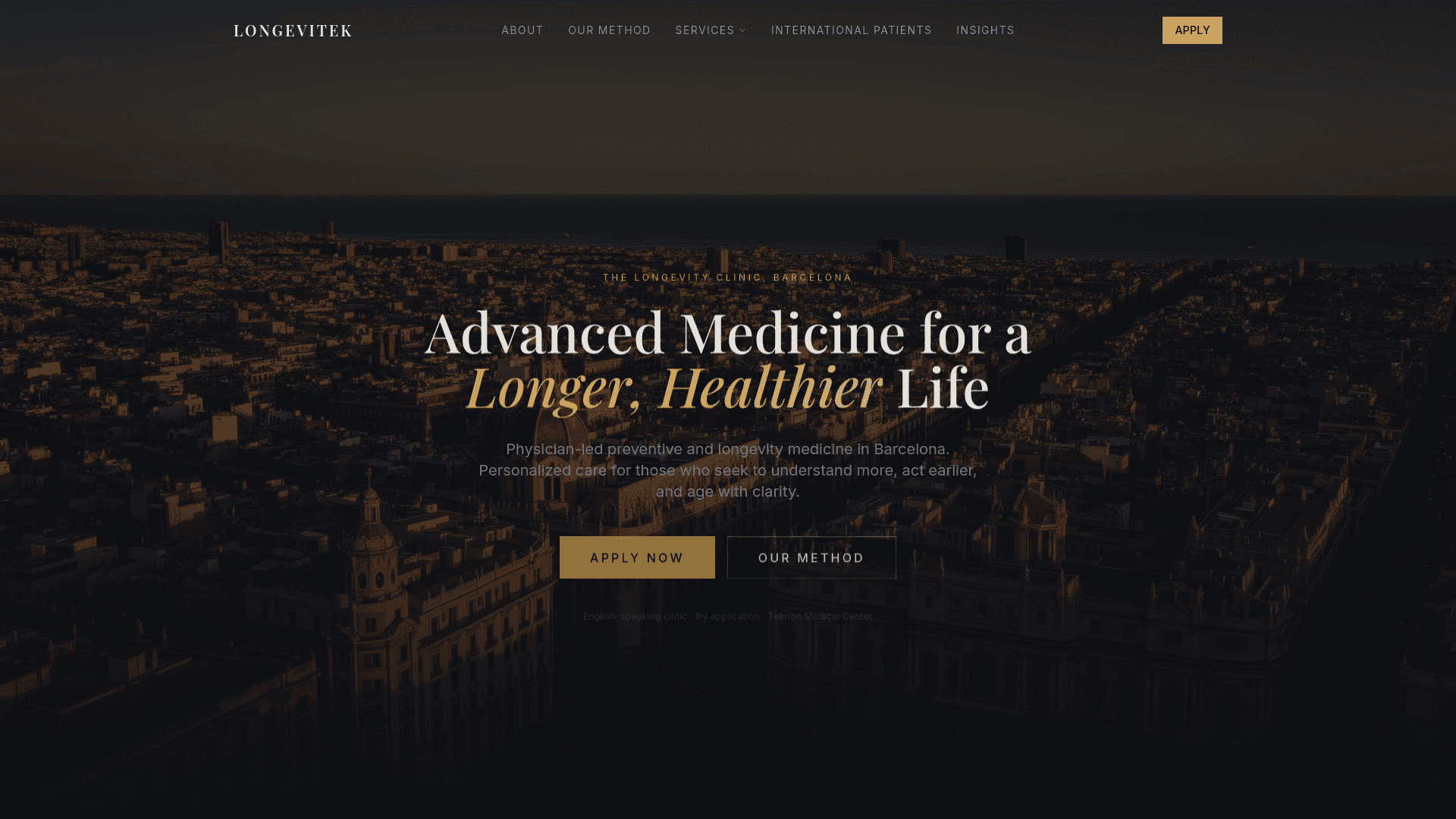
Longevitek is a longevity clinic in Barcelona listing full-body MRI screening and continuous glucose monitoring, alongside other Barcelona clinics.
Monarka Clinic
Barcelona · Spain
Monarka Clinic in Barcelona lists 5 longevity services, including biomarker panels, hormone optimisation, PRP injections and executive physicals.
Alfaz del Pi
Alfaz del Pi guide
Benicassim
Benicassim guide
Valencia
Valencia guide
Cities in Spain
Each city page carries the local listings, the services those clinics offer and what to know before booking there.
What you will find in Spain
Spain's private longevity clinics sell extensive testing to people who feel well, which the public health system does not offer to an adult without symptoms. The Sistema Nacional de Salud, as that system is called, runs three organised cancer screening programmes and nothing resembling a general check-up. The businesses selling the alternative are not one kind of thing: some are executive check-up units inside large private hospital groups, which have run the annual chequeo médico, the paid-for health check, for decades and have lately added biological-age scores and body-composition scans to a format that already existed.
Others are standalone diagnostic centres whose real trade is imaging, selling whole-body magnetic resonance scans or coronary calcium scoring on a computed tomography scanner to walk-in customers rather than to referred patients. A third group is the single-doctor private consulta, a one-room practice usually run by an internist, an endocrinologist or a family doctor, that has bolted preventative panels, continuous glucose monitors and hormone testing onto ordinary private work.
Then there are the residential retreats on the Mediterranean coast and the islands, where a hotel stay is built around a medical assessment, and the single-service operators: intravenous infusion rooms, hyperbaric oxygen chambers and regenerative injection clinics, a good number of them aesthetic-medicine practices that widened their offer.
Longevity medicine in Spain
The Sistema Nacional de Salud is run not from Madrid but by each autonomous community and city, which plan and deliver the screening themselves, and its common services portfolio is set nationally by Real Decreto 1030/2006. Organised screening for the general adult population amounts to three cancer programmes: mammography every two years for women aged 50 to 69; a faecal occult blood test every two years from 50 to 74, an upper limit raised from 69 by a health ministry order of April 2026 that the regions are still phasing in; and cervical screening from 25 to 65, by cytology every three years to age 29 and then a test for high-risk human papillomavirus, the virus behind almost all cervical cancer, repeated every five years when it comes back negative.
There is no publicly organised whole-body scan, no annual biomarker panel and no routine bone-density or hormone check for an adult with nothing wrong.
That absence is a decision rather than an oversight. The Ministerio de Sanidad, the health ministry, runs a standing committee on population screening, the Ponencia de Cribado Poblacional, which tests candidate programmes against published criteria, and it draws a formal line between population screening, where the system invites you, and opportunistic screening, which happens because you asked.
Lung screening met six of eighteen criteria on the ministry's own assessment and sits in pilot programmes still being developed rather than in the portfolio; screening with the prostate-specific antigen blood test was assessed unfavourably in 2011, and the ministry has asked its health technology assessment network, RedETS, for an updating report rather than adding it. The gap those judgements leave is the space private longevity clinics occupy.
Much of what a longevity panel contains has an ordinary route when there is a clinical reason to look. A médico de familia, a family doctor in atención primaria, the public primary care network, can request lipids, glycated haemoglobin - HbA1c, a measure of average blood sugar over roughly the previous three months - and thyroid, kidney and liver tests, and can refer on for colonoscopy, echocardiography or a bone-density scan by dual-energy X-ray absorptiometry, known as DEXA.
Two Spanish rules apply to the paid version. Real Decreto 601/2019 requires that any exposure of a person without symptoms to ionising radiation for the early detection of disease either forms part of a screening programme or carries a specific documented justification, which catches computed tomography and X-ray though not magnetic resonance or ultrasound. Ley 14/2007 requires express written consent specific to a genetic analysis, guarantees genetic counselling when the analysis is done for health purposes, and requires the work to be done by qualified staff in a centre accredited by the state or regional authority.
Longevity medicine is not a recognised speciality in Spain. The official list under Real Decreto 183/2008 contains no longevity or age-management title, and under Ley 44/2003 only the holder of an official specialist title may expressly use the denomination of specialist; the nearest recognised specialities are Geriatría, Medicina Interna, Endocrinología y Nutrición, Medicina Familiar y Comunitaria and Medicina Preventiva y Salud Pública.
Registration with a provincial Colegio de Médicos, the medical association for the province where a doctor works, is compulsory in order to practise, and the Consejo General de Colegios Oficiales de Médicos, the national medical council known as CGCOM, publishes a public search of its central register of registered doctors by name or membership number. There is also the Registro Estatal de Profesionales Sanitarios, the state register of health professionals regulated by Real Decreto 640/2014, and the clinic itself must be authorised by its autonomous community and listed in REGCESS, the national register of authorised health centres, services and establishments, which anyone can search.
The Agencia Española de Medicamentos y Productos Sanitarios, AEMPS, the Spanish medicines regulator, sets the limits on what may be prescribed or injected. Advanced therapy medicines, the category that covers stem cell and other cell-based products, may be supplied only under an EU-wide marketing authorisation, inside an authorised clinical trial, or through the hospital exemption regulated by Real Decreto 477/2014, and in March 2025 the agency warned that some individuals and clinics had been marketing unauthorised versions directly to patients.
Hormones and the GLP-1 drugs - glucagon-like peptide-1 medicines used in diabetes and weight loss - need a prescription, and the agency's position is that prescription-only medicines cannot lawfully be sold over the internet in Spain; peptides circulating as research chemicals are not authorised medicines at all.
Advertising is regulated separately: Real Decreto 1907/1996 prohibits promotion that guarantees relief or cure, that leans on testimonials from health professionals or patients, or that claims preventive or therapeutic effects without sufficient technical or scientific backing. The health and science ministries also run a standing plan against pseudotherapies that publishes evidence assessments through RedETS.
Services available in Spain
Every service listed by at least one verified clinic here, with the clinics that offer it. Each service links to what it is, what it costs and what the evidence shows.
Diagnostic
A longevity blood panel goes well past a routine check-up, adding cholesterol particle counts, inflammation markers, hormones and early metabolic signals.
SHA Wellness Clinic, Monarka Clinic, Palasiet Wellness Clinic, Progevita, Age Reversal
A biological age test estimates how old your body behaves, usually by reading chemical tags on your DNA and converting the pattern into a number of years.
An executive physical packs a year of check-ups into one day: bloods, imaging, a heart and fitness assessment, and a doctor who explains all of it.
A full-body MRI is a whole-body scan that looks for tumours, aneurysms and organ disease before symptoms appear, using magnets rather than X-rays.
A VO2 max test measures the most oxygen your body can use during hard exercise, the fitness number most strongly tied to long-term health.
A continuous glucose monitor is a small arm sensor that tracks blood sugar every few minutes for two weeks, showing what each meal actually does to you.
Therapy
IV vitamin therapy drips vitamins and minerals straight into a vein. It is real treatment for a diagnosed deficiency and weakly supported for anyone else.
NAD+ IV therapy is a slow drip of a molecule every cell uses to move energy around. The reasoning is well known; the human evidence behind it is very thin.
Hormone optimisation is prescription treatment - testosterone, menopausal hormone therapy, thyroid - given for symptoms confirmed by repeat blood tests.
Stem cell therapy injects cells from your own body or a donor, most often into a painful joint. Almost all of it is unapproved and the trials are mixed.
A PRP injection concentrates the healing platelets from your own blood and puts them back into a painful joint, a stubborn tendon or the scalp.
Concierge
Concierge medicine is an annual fee paid to a practice for access: same-day appointments, longer visits, and a doctor who carries far fewer patients.
SHA Wellness Clinic, Palasiet Wellness Clinic, Longevitek, Age Reversal
What it costs in Spain
From this directory
Of the 3 priced clinics in Spain, 1 is in the mid band ($$) and 2 in the upper band ($$$). 3 further listings do not publish enough to place.
Private health insurance is ordinary in Spain rather than exotic, and it has a distinctive public-sector limb: state civil servants covered by MUFACE, the Mutualidad General de Funcionarios Civiles del Estado, choose in set change periods each January and June between public provision through the social security institute and one of the contracted private insurers. What almost none of it pays for is testing bought without a clinical indication.
Spanish policies are written around treating illness and reimbursing diagnostics a doctor has asked for, so a scan or panel you have chosen for yourself is normally self-funded, and the quoted price is the price.
The spread between two quotes usually comes down to four things rather than to quality: whether a doctor spends real time with you or a technician runs a machine and a report follows by email, whether imaging is included and on what equipment, whether the blood work is a standard laboratory profile or a set of specialised assays sent to a reference lab, and whether follow-up consultations sit inside the fee.
Ask which named doctor signs the results and on which register they can be found, whether the clinic is authorised for the services it is selling, and what happens if something ambiguous turns up: who explains it, who arranges the next test, and who pays for that. Get those answers in writing, together with a plain statement of what becomes of your samples and your data afterwards.
Spain does draw visitors for this, particularly along the Mediterranean coast and in the islands, where the residential retreat format sits alongside a long spa tradition that Spain still formally recognises in a specialist title for Hidrología Médica, medical hydrology. If you are travelling in, the harder questions are about afterwards rather than about the visit.
A European Health Insurance Card covers medically necessary treatment in the Spanish public system during a temporary stay, not planned private care and not the follow-up a private result generates, so settle before booking who holds your records, what language the report arrives in, whether your own doctor at home will work from it, and whether the next step needs another flight.
What the evidence says
Independent reviews of the research behind services offered by clinics in Spain. They run whether or not the verdict suits the directory.
Longevity clinics in Spain: common questions
Does the Spanish public health system offer a general health check to people with no symptoms?
No. The Sistema Nacional de Salud, Spain's public health system, invites adults to three organised cancer screening programmes, for breast, colorectal and cervical cancer, and offers nothing resembling a general check-up to a person who feels well. Primary care will still order blood tests, imaging or a referral when there is a clinical reason, so the first move is usually a conversation with a médico de familia, a family doctor, rather than a payment.
Will private health insurance in Spain pay for a longevity check-up?
Usually not. Spanish health policies are written around treating illness and paying for diagnostics a doctor has indicated, so tests you choose for yourself while symptom-free generally fall outside cover, and that holds for the private insurers contracted through MUFACE, the state civil servants' mutual scheme, as well. Assume you are self-funding, read the exclusions before booking, and get in writing what the quoted figure includes and what it leaves out.
How can I check that a doctor at a Spanish longevity clinic is properly registered?
Search the central register that the Consejo General de Colegios Oficiales de Médicos, the national medical council, publishes, which takes a doctor's name or membership number. Registration with a provincial Colegio de Médicos is compulsory in order to practise medicine in Spain, and the state separately keeps a Registro Estatal de Profesionales Sanitarios, a register of health professionals. Ask which named doctor is clinically responsible for your assessment, check them there, and check that the clinic itself appears in REGCESS, the national register of authorised health centres.
Are the tests these clinics sell actually recommended in Spain?
Mostly they are not. Spain's health ministry tests candidate screening programmes against published criteria and through its health technology assessment network, and the organised list has stayed at three cancers: screening with the prostate-specific antigen blood test was assessed unfavourably in 2011, and lung screening met six of the eighteen criteria. That does not make every private test pointless, but it does put the burden of explaining why a particular test is worth doing on the clinic selling it.
Can clinics in Spain legally offer stem cell or peptide treatments?
Only within narrow limits. The Agencia Española de Medicamentos y Productos Sanitarios, Spain's medicines regulator, permits advanced therapy products such as stem cell treatments only under an EU-wide marketing authorisation, inside an authorised clinical trial, or through the hospital exemption set out in Real Decreto 477/2014, and it warned in March 2025 that some individuals and clinics had been marketing unauthorised versions directly to patients. Hormones need a prescription, and peptides sold as research chemicals are not authorised medicines.